 Ashok Bansal
Sequences & sets
A sequence follows consecutive ranks in one suit. A set matches one rank across different suits.
On this page
Test a group with two questions
Ask first what stays the same across the proposed group. If the answer is the suit, look at the order of the ranks. If the answer is the rank, inspect the different suit symbols. These two checks distinguish the common building blocks of Indian rummy. Three diamonds with widely separated ranks share a suit but do not make a run. Three cards with the same corner number can make a set only if their suits meet the conditions for that set.
Try answering with the actual names of the cards rather than pointing at their colour. “Red, red, red” says very little about whether the group works. “Six, seven and eight of diamonds” contains enough information for another player to reconstruct the group from a second pack. That precision is particularly helpful when the screen is narrow or somebody sitting across the table sees the cards upside down.
Spot a natural neighbour
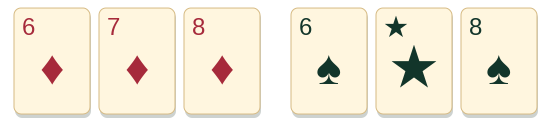
A pure sequence has a place for every rank between its ends, with natural cards doing the work. Give yourself the six and eight of diamonds. You know that the middle job belongs to one particular card. A seven of hearts has the right number; it fails the suit test. A nine of diamonds extends one end in theory, yet it leaves the original hole open. Lay down the diamond seven and you can trace the complete sequence without guessing.
Now build another row with six and eight of spades and a printed joker in between. This time there is a card occupying each place, and you can still describe three consecutive spades. What differs is the way the middle place is supplied. Mark the first row pure and the second impure. Both may be useful in a complete hand, but if you have only the second sort you still need to look elsewhere for a natural run.
Identify sets in a mixed pack
A natural set brings together equal ranks from different suits. Put down a seven of clubs and a seven of diamonds. A heart seven would give you a three-card set. A spade seven would also finish it, and both together could extend it to four. The suit names matter even in a game using more than one pack. Two copies of the seven of clubs are still both clubs when they come to rest side by side.
For a practical check, arrange a proposed set with the corner pips visible in a straight line. Cover the large centre artwork with your hand and look only at those corners. Do you see a repeated symbol? If so, decide whether a different copy belongs in another group. One physical duplicate may fit a run held elsewhere. The task is to find places for all the cards, so a duplicate that fails in one arrangement can still make a useful contribution in a different one.
Place an ace at a real end
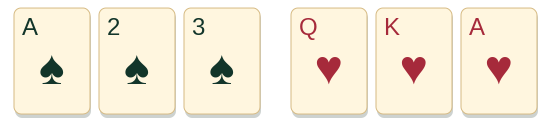
An ace has two possible ends available under the Indian convention used in these lessons. Ace, two and three of spades works as a low sequence. Queen, king and ace of hearts works as a high sequence. Pick one arrangement at a time. A king next to an ace next to a two does not create a bridge between the top and bottom of the pack. The ranks have an end rather than forming a circle.
Lay an ace between two unrelated groups if you want to test both possibilities. On its left put the two and three of its suit. On its right put the queen and king of the same suit. Slide the ace left and count the unused high cards. Slide it right and count the unused low cards. Either run is sound by itself. Whether one choice is better depends on the rest of your hand and on the value of the cards you would leave ungrouped.
Give the substitute one precise identity
A joker becomes much easier to use when you can name the card it replaces. Between a heart nine and heart jack, the missing natural identity is a heart ten. At the open end of a suitable pair the joker may have more than one possible identity. Before declaring, choose an identity that produces a valid arrangement and leaves the rest of your hand correctly grouped. Pointing to the star and calling it “anything” avoids the very question that needs checking.
What if you later draw the missing natural card? Briefly take the joker out, put the new card into that vacancy and look at the result. A previously impure sequence may now qualify as pure, while the freed substitute becomes available elsewhere. Count how many qualifying sequences exist after the entire change. Replacing a joker is particularly useful when two incomplete groups improve together, but it still uses one turn and requires a legal discard.
A shared card creates a choice
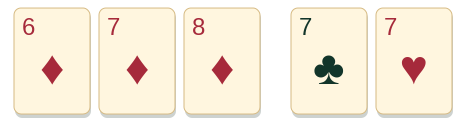
Imagine the diamond six, seven and eight alongside the seven of clubs and the seven of hearts. You can point to a natural diamond sequence or to three different sevens. To show which cards you are actually claiming, slide the club and heart sevens a little further away. Move the diamond seven into that pair. There is now an obvious space in the diamond run. The apparent ability to show both groups came from counting the diamond seven twice.
This is a good position for a one-card experiment. Introduce the spade seven and leave the original diamonds untouched. The three off-suit sevens can now stand as their own set. Instead introduce a second diamond seven from another deck. One copy can occupy the middle of the run while the other can join the heart and club sevens. In each case one extra physical card changed what could be shown simultaneously. The rules about distinct suits inside the set remained exactly the same.
Separate a complete group from a useful pair
Pairs are often worth keeping during play even though they cannot be declared as complete three-card groups. Four and five of clubs can improve at either end. Four and six of clubs need the five to fill their middle if you are looking for a three-card run. A pair of queens waits for a distinct suitable suit. Describe a pair in terms of the cards that would improve it, and describe a completed group in terms of the cards you already hold.
A player learning to arrange thirteen cards can use two rows. Put completed groups in the front row and prospective combinations behind them. After a draw, move a whole group forward only when the new card makes it valid. You are still free to reconsider its members later. The rows simply make it harder to look at two tidy pairs and mistakenly count them as the two sequences required to finish.
Teach a mistake by changing one detail
Start a teaching puzzle with one sound arrangement. Ask somebody else to turn away, replace a single card and let them discover which rule failed. Replacing a heart nine with a diamond nine tests suit recognition. Replacing it with a heart jack leaves the suit intact but changes the rank spacing. Switching it for a joker can leave the sequence valid while changing its classification. Those are three different answers to the same question about what changed.
Give the learner a chance to repair the layout without telling them which card you removed. They may find an unexpected second solution. If they keep a different pair and name another card that completes a set, check their proposal on its own terms. In a full hand there is often more than one possible grouping. The best explanation identifies the actual cards used, shows that no card appears twice and accounts for every requirement of the intended declaration.
Two ways to repair the same layout
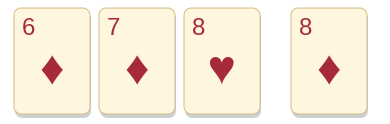
A group can be one move away from becoming valid for two entirely different reasons. Lay down 6♦ 7♦ 8♥. The ranks already follow one another. Replace the eight of hearts with the eight of diamonds and the group becomes a pure diamond run. Now try replacing the six instead. Another heart does not help: the seven of diamonds still interrupts any attempt at a heart run. Look for the property shared by two cards before deciding which single card to change.
Put the eight of hearts back, remove the seven of diamonds and bring in the six of hearts. You now have two sixes and an eight. A six of spades could replace the eight to make a set. Although you began the exercise looking for a sequence, the cards now offer a different repair. A printed joker in place of the eight may also complete a group under rules allowing it in sets, but cannot produce a pure sequence from two natural cards of the same rank.
These small swaps are easier to learn from if you keep the previous layout visible. Use a pencil to record the three ranks and suits before taking a card away. Circle the card you changed. Underneath, write one short explanation, such as “replaced the off-suit eight” or “added the missing rank in a third suit”. A list that says only “right” or “wrong” leaves you with very little to recognise the next time a similar shape appears.
Check the ends before splitting six cards
A natural run of six consecutive cards can split neatly in two. With 2♠ through 7♠ you can lay down two, three, four and then five, six, seven. Each resulting sequence still has the minimum three cards and the groups share no card. A five-card run cannot split into two three-card groups in that way. Moving its middle card back and forth just shows two possible layouts, not two complete groups.
Before splitting, ask what else the longer run is doing for your hand. If the top seven belongs much more usefully in a three-suit set, keep the lower five as one run and see whether you have a second sequence elsewhere. A good arrangement answers a question about the whole hand. It does not always have the largest number of groups you can make from one suit.
Name the missing card without a diagram
Ask a partner to describe two cards over the phone. If they say “a five and a seven”, ask one more question before offering a solution. Are the suits identical? With two clubs the missing club six would complete a natural run. With a diamond and a spade, no amount of wishing for the right six can make those three into a natural sequence. A useful answer sometimes begins by finding out what information has been left out.
Switch the question to two equal ranks. This time ask which suits are already represented. If both are queens of diamonds, the pair needs more than the addition of a single natural queen to form a valid set of distinct suits. If one is a diamond and one a club, either of the remaining suits could help. Practising verbally is surprisingly effective because nobody can rely on a similar colour or a familiar arrangement of pictures. You have to supply exactly the details that make the group valid.
Questions at the table
What is a pure sequence in rummy?
The 7♥, 8♥ and 9♥ make a pure sequence. All three hearts are present in order, and no substitute fills a gap. Replace the 8♥ with a printed joker and the run becomes impure.
Can I use two identical cards in a set?
Two 8♥ cards from different decks still repeat a suit. Use combinations such as 8♥ 8♦ 8♣. A fourth eight can join only if it adds the missing spade.
Can an ace follow a king?
Aces may sit low in A–2–3 or high in Q–K–A. K–A–2 wraps around the end of the rank order and does not make a sequence.
Can a run contain only red cards?
Yes, provided all its cards belong to the same red suit and meet the rank requirement. Hearts and diamonds cannot form a natural run together.
Can two groups share a card?
A final layout uses each physical card once. An overlapping card offers a choice between layouts.
Can I split a six-card sequence?
Six consecutive natural cards of one suit can split into two consecutive groups of three.