 Ashok Bansal
Rummy points
Count the cards left outside eligible groups to work out a hand’s penalty under your table rules.
On this page
Decide what the number represents
A rummy score records the consequences of a particular hand under a particular agreement. It is useful to write the format at the top of the paper before writing either player's name. A single-hand penalty, a running pool and a fixed series of deals all use familiar-looking numbers. Reading a number from the wrong column can change who you think is ahead even when the arithmetic is perfect.
For a first exercise, agree that the player who declares a valid hand records no penalty for that deal. Each opponent identifies eligible groups and counts the cards still liable to score. Keep these numbers as plain points. You do not need a price per point, a buy-in or an account to work out whether the loose queen and six add up to sixteen. The point of a paper example is to understand how the cards contribute, one small decision at a time.
Price a single loose card
Start with numbered cards from two through ten. A loose five contributes five points under the convention used here, whether the suit is a heart or a club. The rank tells you the value. A loose queen, king, jack or ace contributes ten. This is different from the ace in the gin lesson. In Indian rummy an ace may sit beside a two in a valid run while still counting ten if left out on its own.
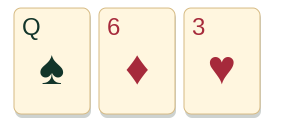
Keep the wild indicator visible. Take a queen of spades, six of diamonds and three of hearts as your loose cards. With no applicable wild among them you have ten, six and three for nineteen. If six is wild and the table counts its value as zero, the subtotal is thirteen. Nobody has made a second draw. You have identified a rule which already applied to the cards on the table. Trying to reconstruct that fact from memory after the pack has been shuffled is a poor substitute for checking the indicator first.
Establish the first sequence
Before adding unmatched ranks, decide whether the hand has met the condition for protecting groups. In the examples here an eligible natural sequence protects the cards inside it. Other groups gain protection according to whether the required sequences are present. At a new table, ask how a hand lacking a pure sequence is treated. A neatly displayed set of kings does not automatically take thirty points off a losing hand if the table's basic sequence requirement has not been met.
Practise the distinction with two positions on the same sheet. In position one you have an obvious natural club run and several unmatched cards. In position two a printed joker fills a gap in that club run and there is no other pure sequence. The picture of the table has barely changed. The scoring question has changed substantially. Write down exactly why each group is protected before crossing out its ranks. If two people disagree, they can then discuss the grouping rule before anyone reaches for a calculator.
Try more than one arrangement
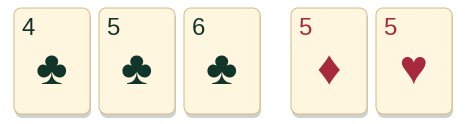
When one card could join a set or finish a run, calculate the two layouts independently. Imagine the four, five and six of clubs with the heart and diamond fives nearby. Assign the club five to the sequence first. Mark the remaining two fives on a spare line. Then remove it from the sequence and place it with the other fives. Replace the line of unmatched ranks with the club four and six. A card cannot be crossed off on both lines of one layout.
The two pairs both add up to ten. That fact alone will not necessarily make the layouts equivalent. You might have removed your only natural sequence in order to arrange the three fives. Or another sequence elsewhere might already secure the relevant condition. This is why you need the other eight cards before announcing the final hand penalty. A five-card fragment can teach you how to compare arrangements, but it cannot reveal the status of an entire deal that you have not seen.
Apply the table's limit last
Some points tables cap an ordinary losing hand. A cap sets the maximum award for that calculation; it does not change the printed value of a king. Suppose a table has agreed a limit of eighty and a player has ninety-three chargeable points before the cap. Record the raw count in your notes, apply the maximum once, and enter eighty on the score sheet. With seventy-three chargeable points under the same rule, the entry remains seventy-three. The limit does not round every hand up to eighty.
A fixed penalty is a different kind of entry. If the table assigns a specified figure for an invalid declaration or for leaving a deal early, start by identifying that event. Do not quietly add the fixed figure to an ordinary losing subtotal unless the rules specifically require both. A clean score sheet can distinguish “cards counted” from “agreed penalty” in a few words. That small annotation often prevents a long argument three rounds later.
Settle one deal before starting the next
In a single points deal, completion of the hand is a natural stopping place. Put the winner's valid layout face up and count the other hands in turn. Give each player enough space to show the groups they want protected. If cards are pushed together into a communal heap before the last opponent has checked their count, an honest difference of opinion becomes almost impossible to resolve.
For a pencil-and-paper exercise, ask one player to say the ranks while another writes the subtotal. Make the writer read the values back in the same order. Saying “queen, three, eight” and hearing “ten plus three plus eight” checks the translation from picture to number as well as the addition. If you discover two players have been giving a loose ace different values, settle which game you meant to score before discussing the total. One may have carried over a rule that belongs to gin.
Watch the pool threshold
In a pool match the next hand is added to a running penalty. The question is no longer simply who had the fewest chargeable cards in one deal. A player with a small penalty can cross the elimination line sooner than somebody who just suffered a much larger loss. Before the first hand, agree whether reaching the stated threshold is enough to leave the pool. Mark the threshold prominently so that an exact tie with it does not become a surprise.
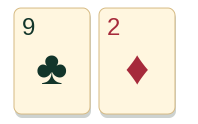
Try the narrowest possible test. A player brings ninety into a 101 pool and adds a nine and a two. The new total is exactly 101. Under a reaches-the-limit rule, the player leaves immediately. If the old total had been eighty-nine, the same cards would have produced one hundred. Keep these two examples together in the margin. They use precisely the same losing hand and demonstrate why the brought-forward entry deserves as much attention as the latest subtotal.
Compare a fixed series fairly
A deals match has a planned length. Count how many deals each participant has actually played before comparing their final positions. With two deals left, a player behind on the sheet still has opportunities that a player in a finished single-hand game no longer has. Which direction on the sheet counts as leading depends on how your table records rewards and penalties. Agree the notation rather than assuming everybody interprets a positive entry the same way.
Mark the last scheduled deal before it starts. If two participants finish level, use the tie procedure agreed for that match. Deciding to add another deal only after seeing who tied can change the terms for everyone. For a friendly teaching session you can leave the tie standing and go back to the more interesting question: which set of cards caused the largest change between the starting and finishing totals? Being able to reconstruct that swing is a better sign of understanding than memorising a final score.
Keep one score sheet from start to finish
A score sheet is easiest to audit when every row shows the score brought forward, the hand penalty and the new total. Imagine a three-player pool with a limit of 101. Before the next deal Meera has 61, Kabir has 77 and Dev has 84. Meera declares with a valid hand. Her new entry is zero, so her total remains 61. Moving her old score back to zero would erase earlier deals as well as giving her credit for this one.
Kabir has two eligible sequences and three remaining cards worth ten, four and two. Write sixteen in the hand column. Then add it to his previous seventy-seven and enter ninety-three in the total column. Dev has already checked his groups and counts an eight and a nine for seventeen. Eighty-four plus seventeen is exactly 101. If the agreed pool eliminates a player on reaching 101, Dev is out at the limit itself. There is no further hand in which he can attempt to get back below it.
Read the sheet aloud in the same order in which you wrote it. Meera stays on sixty-one; Kabir goes from seventy-seven to ninety-three; Dev reaches one hundred and one. If a player disagrees, you can now identify what they dispute. A disagreement about whether an eight belongs in a sequence sends you back to the cards. A disagreement about adding seventeen to eighty-four can be settled on paper without disturbing the hand.
Compare hands before comparing totals
To compare two scoring arrangements, start with the same loose cards and alter just one assumption. A queen, a six and a three make nineteen under the ordinary face values used here. If six was the declared wild rank, that particular six contributes zero under the example rule. The subtotal falls to thirteen. Nothing about the queen or three changed, and the scoring convention did not change halfway through the hand. You simply identified which card the agreed rule applied to.
Keeping the indicator beside the score sheet until everyone has agreed is a simple courtesy. Once the cards have been shuffled into the pack, it becomes much harder to show why a written subtotal differed from somebody’s first mental count.
Resolve a disputed subtotal
When two totals disagree, locate the first card on which the scorers differ. Set the hand back down in its groups and place a small space between each group. One scorer points to a card; the other says either its penalty value or the reason for excluding it. A difference over a wild six is settled by looking at the indicator. A difference over a picture card used twice is settled by moving the physical card and counting the group left behind.
If all the card decisions match, compare the hand subtotal with the line brought forward. A common mistake is to copy the last deal's penalty instead of the cumulative pool total. Another is applying an elimination threshold to this hand alone. Neither mistake requires changing the arrangement of the cards. Put the old total and the latest penalty beside each other once more, perform the addition and ask both scorers to read the resulting line. Then the next deal can start on a score everybody understands.
Questions at the table
How many points is each card worth?
In typical Indian points rummy, number cards carry their face value. Jacks, queens, kings and aces count ten each. A joker carries zero penalty points.
How do you calculate a losing hand?
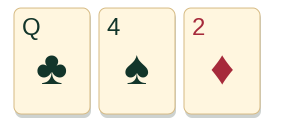
After protecting your eligible groups, suppose only a queen and a four remain loose. That gives 10 + 4 = 14 points. If the hand lacks a pure sequence, do not automatically exempt its other groups.
How do points, pool and deals rummy differ?
Points rummy settles each hand separately. Pool rummy accumulates penalties towards a table limit. Deals rummy compares scores after an agreed number of deals. Check the format before keeping score.
What is the penalty value of a printed joker?
The scoring examples on this page assign a printed joker zero penalty points.
How do I record a winning declaration?
Enter zero hand penalty for the declarer. In a cumulative pool, carry the previous total forward.
What happens at exactly 101 points?
In the example 101 pool, reaching the threshold eliminates the player. Agree on the threshold rule before the first deal.