 Ashok Bansal




Ashok Bansal
Welcome bonus concept
500% on your first deposit
+ 500 free spins

Find the pure sequence
Twelve hands to practise runs, sets and jokers.
Gin rummy for two
Ten cards each. Build melds and count your deadwood.
Explore the card room
 Indian rummy
 Gin rummy
Ashok Bansal
Practise a hand of Indian rummy, learn the rules and explore the slot catalogue.
500% + 500 free spins · Concept
Get bonusOn this page
Inside the Ashok Bansal card room
Ashok Bansal is a free Indian rummy practice club built around the decisions you make with a hand of cards. On the banner, the host holds up a phone beside three hearts. Read them in order and you have already found a pure sequence. The practice button takes that simple example one step further: the cards arrive mixed together and you decide which three belong on the felt.
The working table sits alongside a catalogue of studio slots and a proposed welcome bonus. Each has its own place in the lobby. You can play the card puzzles now, compare slot names and studios, or read the proposed offer on the welcome banner. For a first hand, choose Practice and leave the account controls for another time. You can go straight from spotting a sequence to checking it without entering a name or installing anything.
Your first minute in the lobby
The quickest route to a playable hand is the button beside the welcome offer. It opens six cards in the same tab. There is no seat to reserve, no stake to choose and no need to remember a password on the way back. You can make your first choice as soon as you recognise a suit. If you would like to understand the deal before committing to a move, read the sentence above the rack. It specifies the kind of group the table wants you to find.
There is another route for someone who knows exactly what brought them here. Open the club search and type a word such as points, practice or gin; use the page title that matches your question. On a narrow screen, open the club menu first. Once inside a long lesson, its contents list jumps to a particular example. That saves a fair amount of scrolling if you came back specifically to settle whether an ace can sit on the other side of a king.
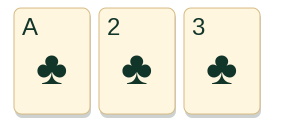
For someone learning by watching, leave the first slide in view for a moment. The three hearts beside the host already satisfy a rule that a brand-new player can test. Cover the centre card with your finger. You can name both its rank and its suit from the two cards beside it. That little observation is the difference between seeing three red shapes and reading a sequence. Uncover the card and check whether your prediction was precise enough.
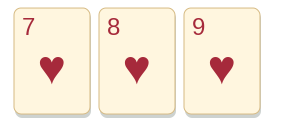
One rack, two quite different questions
When you open a practice rack, the question matters as much as the cards. With three consecutive ranks in hearts, you have something a sequence drill will accept. In a set drill the very same arrangement is useless. Pull the middle eight away from those hearts and give it an eight of diamonds and an eight of spades instead. All three cards now answer to the name eight. Their symbols deliberately disagree. A learner who thinks the task is always to match colours will miss that answer.
You can reproduce both situations at home with five cards. Take seven, eight and nine in one suit plus two other eights. Ask a friend to find a group, but leave the question open. They may put down a run or a set. Then ask for both groups at the same time. If they lay the two arrangements partly on top of one another, point to the eight trapped in the middle. There is one physical copy of it on the table. Choosing a role for that card is a real decision in a full hand.
When you try the question again, add the fourth eight to the rack. Suddenly both answers can stand at once: the suited eight stays in its sequence and the three other eights make a set. Very little changed visually. One extra card changed the number of complete groups the whole layout could support. This is a better way to learn what a promising draw means than simply counting how many attractive pairs lie on the felt.
Pick a format before counting your cards
Indian rummy and gin share the pleasure of finding combinations, but the two tables ask you to finish in different ways. Choose the Indian lesson if you have thirteen cards or if someone has asked whether you have a pure sequence. A player declaring there has to account for everything left after the last discard. Find the qualifying runs, put each remaining group down separately and make sure there really is a place for the card you kept hidden behind a queen.
Gin is a useful choice when two people have one pack and want a game with a different ending. You can reach a decision about knocking with a small amount of deadwood still in your hand. The opponent's arrangement can then affect the score. This leads to a question an Indian declaration does not pose: is a modest knock now worth more to you than one more chance to improve a nearly complete hand? The gin page gives you cards to lay out on both sides before trying that decision unseen.
The single-player practice rack is smaller than either complete game. There is no unseen opponent collecting discards and no running match score. Six cards let you repeat one recognition task without spending the rest of the evening waiting to see the same pattern in a shuffled pack. Use a rack to learn the shape of a group, then use the relevant rules page to learn how that group behaves during an actual deal.
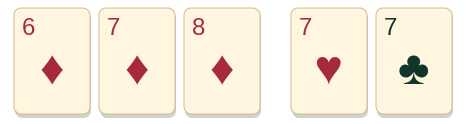
Follow a single card across the table
Consider a seven of diamonds that arrives face up when you already have the six and eight of that suit. You know exactly what accepting it would do. Place it between the six and eight and the gap closes. Now add a seven of clubs and a seven of hearts to your original holding. The visible diamond also completes a set. Before reaching for it, decide which use helps the rest of your hand. It might secure your first pure sequence, or it might allow other cards already grouped in diamonds to stay together.
A quick way to compare the choices is to leave a space on your left for completed combinations. Put down only groups you could show immediately. Keep cards that still need help on your right. Try both arrangements of the seven and watch which cards move back to the unfinished side. A pair of off-suit sevens is waiting for a different kind of help from two diamonds separated by a hole. Saying what the next useful card would be makes each choice easier to explain.
This exercise teaches a language for discussing a draw without pretending to know the contents of the stock. You know which visible card solves a particular problem. You do not know whether anyone else holds the other sevens, whether another diamond will turn up or whether the next player will finish before your next turn. Explain the gain that you can see, then identify what still has to happen before the hand can close.
Play a hand of Indian rummy
Choose a set, a pure sequence or a joker run.
Deal a handKeep the count while you rearrange
Draw and discard are easy to remember until a hand gets interesting. An unexpected queen completes a set, someone next to you starts counting points, and suddenly you cannot remember whether the card beside your elbow was the one you meant to throw away. A simple routine helps. Put the new card down just beyond your existing hand. Move it into a group only after naming the card you expect to discard. Before handing over the turn, check how many cards you actually kept.
Try the routine with three finished groups and one loose pair. Suppose your closed groups contain four, three and three cards. That accounts for ten of thirteen. If you also have a loose pair, there is still one more card somewhere. It might be stuck beneath the four-card run or resting beside the stock. Finding it now changes the decision you make. Discovering it after a declaration is a much more awkward way to learn arithmetic.
When one player is teaching another, ask for a count by groups rather than demanding all thirteen names in a breath. Four here, three there and three there leaves three to explain. The learner can point to exactly where the uncertainty lies. The next time through the same example, ask for the suits as well as the counts. Four adjacent cards of the wrong suits may still add up to four, but they will not form the same run.
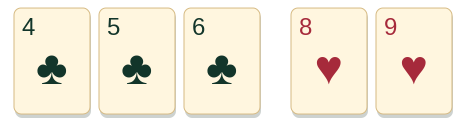
Read the figures on the points table
A point is a unit used to record a hand. It takes its meaning from the rules of the chosen format. In Indian points examples, an ungrouped face card can be costly even when it looks impressive beside a pair. In gin, an ace has a different deadwood value from the one used in many Indian tables. Decide which page belongs to the game in front of you before writing numbers beside the cards.
To see how much grouping matters, look at the four, five and six of clubs next to an eight and nine of hearts. Counting every card by face value gives a perfectly respectable sum. It may also answer entirely the wrong question. The clubs already form a pure run. The hearts await one of their neighbours. A scoring rule that recognises completed groups treats the two parts differently. First show why each group qualifies. Only then total what the chosen rule tells you to count.
Keep the written record simple enough for the next player to check. Record a hand result in a fresh box, then update the running total in another. If someone discovers that a card you counted was actually wild, you can repair the hand entry and add it again. Erasing the running total without finding the mistaken entry loses the explanation. The worked sheet on the points page walks through exactly that sort of discussion with a threshold and three players still sitting at the table.
Share a lesson between English and Hindi
At a mixed-language table it helps to agree on four suit names before introducing the rules of a declaration. Deal a heart, a diamond, a spade and a club face up. Let each person give their usual name for each one. Now give an instruction about a rank and a suit together. Asking someone to move the red four can produce two reasonable answers. Asking for a particular four of diamonds settles the choice even when the two players learned different words at school.
The Hindi lesson uses printed examples in Devanagari; the English trainer uses a corner rank and a central suit mark. You can keep the lesson visible on one screen while somebody else taps a puzzle on another. Start slowly enough that the person explaining the move has time to finish the suit name. Then swap jobs. The person who was listening now has to describe which card replaces a joker and which two natural cards make the substitution possible.
To make the lesson memorable, leave one deliberate mistake in a hand that is otherwise correct. Replace a heart with a diamond of exactly the same rank. Ask the other player to explain in their chosen language what must change. An answer that names both the misplaced card and its replacement is much easier to act on than saying the group looks wrong. Once the explanation works in conversation, the same symbols will be easier to read on a small screen.
Explore the six lobby tiles
Four destinations in the grid lead into the card club. Choose the practice tile to interact with a deal. Indian rummy opens the rules for the longer hand. Gin rummy takes you to the ten-card game for two. Sets and sequences gives you a place to look up a combination without reading an entire match from the start. On a phone the grid wraps, so read the short name beneath the artwork rather than relying on the position you remember from a wider screen.
The other two tiles are studio entries. Sweet Bonanza belongs to Pragmatic Play and Book of Dead to Play’n GO. Opening either entry gives you its description and launch status. There is a practical difference between opening a catalogue description and starting a game session. The studio name and artwork identify the title; neither creates a playable connection. Close the panel to go straight back to the same position in the lobby.
If a visitor asks where the menu went on their phone, point them to the small menu button in the header. The pages that occupy the left column on a desktop are available in the drawer. On both layouts the search is local to this club. A search for a game rule does not submit a registration, leave the domain or activate the installation destination. Those actions each have their own visible control.
Play through a puzzle with another person
One phone and an ordinary pack of cards are enough for a useful two-person session. Let the first player hold the screen and read the ranks aloud, giving the suit of each one. The second player builds that rack from a physical deck. Before either person selects an answer, compare the two layouts. A missing diamond or a jack mistaken for a king makes the two people solve different puzzles. Catching that mismatch is part of the exercise.
Next let the person holding the physical cards present their proposed group. The person at the screen checks it. After a successful check, take one card away and ask the other player to name a possible replacement. A natural run may have room to grow at one end, while an inside gap usually demands a specific rank. A set of three distinct suits can accept a fourth individual suit. Decide whether your suggested change extends the group, repairs a hole or changes its identity altogether.
Finish by comparing two possible failures. In the first, the ranks are consecutive but one suit is wrong. In the second, the suits agree but the ranks skip a number. Both can earn the same response from a checker. They ask for different repairs. Being able to explain which error occurred is a useful skill to carry into a larger hand, where the ungrouped cards may have several quite different ways to improve.
The welcome offer in the club lobby
The Ashok Bansal welcome concept pairs a proposed 500% first-deposit bonus with 500 free spins. Get bonus in the banner or header opens the external offer in the same tab. Check the terms there before deciding whether to register. The free card table is available immediately. The commercial offer is shown as a concept, with deposits and claims unavailable. There is no requirement to open an account before trying a hand.
If a friend sends you a picture of the banner, the number beside the percentage sign and the number beside the spins describe different things. The percentage is relative to a first deposit. The spin count refers to rounds. The artwork supplies neither a rupee cap nor an eligible slot list. In particular, recognising a Sweet Bonanza cover further down the lobby does not make that title an eligible game for the offer. A slot card identifies the game and studio; the bonus panel describes the offer.
For the shortest route back to the cards, return to the club and select Practise a hand. The six-card deal opens in the browser. On a shared phone you can pass the screen to the next player after checking a group, or go straight to the Hindi lesson and read the names of the suits together. Both choices are available from the club itself, independently of the Install button at the very top of the page.
Questions at the table
Who is Ashok Bansal?
Ashok Bansal is the name used by this independent card-room concept. Here you can practise rummy hands without an account. The name alone does not establish a connection to a particular person or casino operator.
Can I play rummy online for free?
Yes. Choose Practice, pick three cards and check your group. Each of the three exercises offers four hands, with instant feedback and no entry fee.
What is the Ashok Bansal welcome bonus?
The concept offers 500% on your first deposit and 500 free spins. Deposits and bonus claims are currently unavailable. Free rummy practice needs no deposit.
How many cards are dealt in Indian rummy?
A player starts with thirteen. Drawing brings the hand to fourteen and the discard restores thirteen.
Do I need to install anything to practise?
The six-card practice table runs in the browser. Install opens a separate external destination.
Can I play against a friend here?
The club offers individual puzzles. Two people can discuss a hand on one screen, or follow the gin rules with a physical deck.
Which drill uses a printed joker?
Choose Joker run on the practice page. Select the joker and two natural cards that it can join in one suited sequence.
Where can I find the rules in Hindi?
Choose हिन्दी in the quick links or open रम्मी कैसे खेलें from the menu.
How is gin rummy different from Indian rummy?
Gin normally deals ten cards to each of two players. A player can knock with qualifying deadwood, while an Indian declaration requires a fully grouped hand.
What happens when I open a slot card?
The card opens local details about the title and studio. Slot launches are unavailable in this concept.